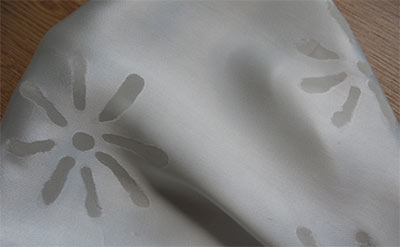
Learn how to devore fabric with Fiber Etch Fibre Remover. Fibre Etch dissolves cellulose plant fibres but does not affect protein animal fibres. It can be applied freehand, using a stencil, or in screen printing.
You can create devore (from the French devorer – meaning to devour) by using a devorant paste on a mixed fibre fabric. The devorant destroys (burns out) viscose and plant (cellulose) fibres such as cotton, linen etc and leaves other fibres such as polyester and animal fibres, like silk and wool, intact. It is used to best effect on Velvet fabric where the viscose pile is eaten away and the silk backing remains in place.
Devorants can also be used to burn holes in cellulose fabrics such as 100% cotton and linen to create a lace-effect fabric. Often these holes are prone to fraying, making the fabric unsuitable for clothing.
The fabrics suitable for creating devore fabric with Fiber Etch are: undyed silk/viscose Velvet, black silk/viscose Velvet, Silco (57% silk / 43% cotton ) and silk/viscose Satin.

Before you Begin
- The reactant contains Sodium Bisulphate, which is a corrosive compound and can cause burns or become a respiratory irritant. Take care to use in a well ventilated room and rinse well with water if in contact with skin and eyes.
- Store out of the reach of children.
- Always test on a sample of fabric before beginning a project.
- Regulate the heat when activating the devorant as too much can cause blackening to treated areas
Instructions for Fiber Etch Fibre Remover
(download a PDF of Material Safety Data Sheet)
This product is slightly different from Dupont Devorant. It is recommended that the gel be applied to the front or pile of the Velvet and to the reverse of the fabric if it is being applied through a silk screen during screen printing. Unintended spills of Fiber Etch can be removed by sprinkling baking powder over them while still damp or they can be washed out with soap and water. Do not leave Fiber Etch on fabrics overnight.
The 118ml Fiber Etch comes in a flexible plastic bottle and has a spout shaped dispenser.
- Pin fabric to a frame and draw a design using a vanishing fabric marker.
- Squeeze the bottle to release the gel and apply a thin layer (not raised) to the fabric. Use the spout to scratch the surface of the fabric and ensure that the gel has penetrated the fibres.
- Leave the devorant to dry completely. A hair dryer can be used to speed drying.
- To activate the devorant: ALWAYS WORK IN A WELL VENTILATED AREA, as ironing will release an acrid vapour.
- Place a cloth between the piece of work and the sole plate of the iron.
- Iron the dried work on the reverse of the design on a wool setting without steam. Test treated area periodically with a finger and stop ironing once the Fiber Etch becomes brittle. Do not overheat or over iron.
- Wearing rubber gloves, rinse the fabric under running water. Carefully rub away at the design to help the fibres to fall away. Take special care when removing the devorant from finely woven fabrics to prevent tearing.