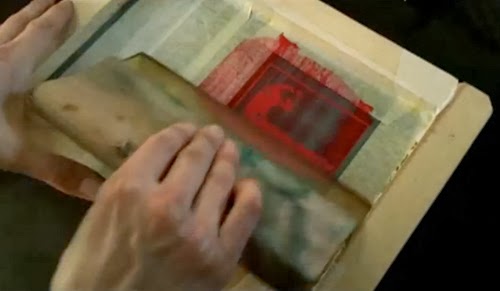
Lino Printing Lino printing is a subtractive process, meaning you cut away the areas you do not want to print. The remaining raised areas are inked with a roller (called a brayer) and a sheet of paper or fabric is placed over the inked lino block. The back of the paper is then either burnished […]
Category Archives: Printing
Continuing from our previous post about screen printing with Jacquard Discharge Paste, we now have Jacquard Screen Ink Discharge Additive available for screen printers. The additive helps to achieve bright, vibrant screened colours on dyed dark fabrics without laying down an undercoat of white ink. This means that layers of ink do not need to […]
With such a large range of materials available to artists it can sometimes be difficult to know where to start. There is a huge choice of watercolour papers on offer and the artist will usually settle on a brand after some experimentation. The highest quality paper is made from 100% cotton. However a combination of cotton […]
Thicken paints or dyes using the following methods to create unique hand printed textiles. RESISTAD WATER-BASED GUTTA Resistad is a concentrated, viscous water-based medium which can be used as a gutta resist in silk painting, or as a printing paste for screen printing, block printing, and stamping. To use as a printing paste, start with […]
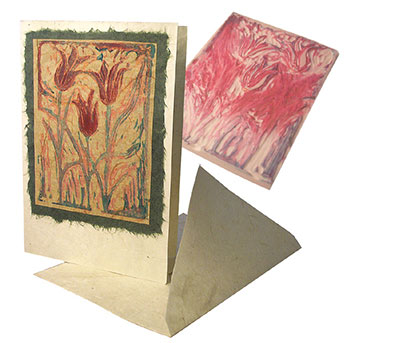
This is an effective method of batch producing handmade cards. We suggest you keep your initial designs simple by choosing shapes such as the flower head we have used. You will need the following block printing equipment: Making the Block The design for this card was cut in 3 stages. Alison used Jacquard Textile colours […]
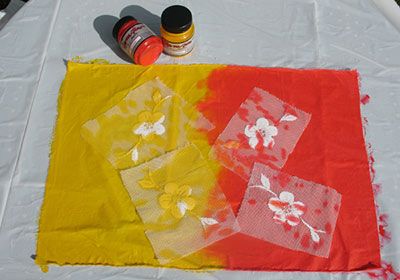
Sun Printing with UV Light Some fabric paints are formulated so that any colour, covered by an opaque stencil or flat object, “bleaches” away when exposed to sunlight or other Ultra Violet light sources, such as a UV lamp. The original version of this post was created before Jacquard launched the superior Solar Fast dyes […]
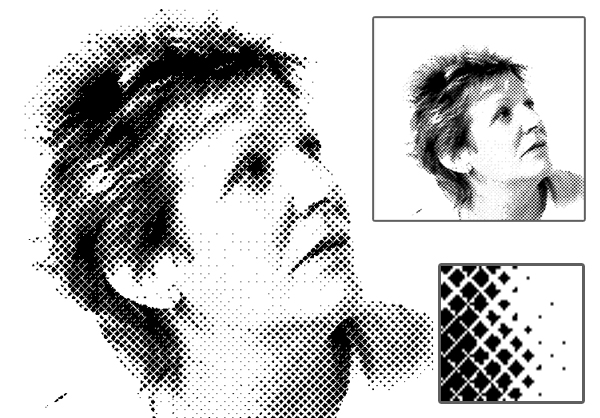
Halftone prints can be used to create stencils for screen printing Halftone is a reprographic technique which simulates greyscale imagery. It does this by using black dots in different sizes set at varying distances to each other. A halftone image can be printed onto a clear acetate sheet, placed on a screen treated with Diazo Photo Emulsion […]
Fabric artists today spend as much time taking colour out as putting it in. This gives their fabrics a richness that is only obtained by putting this extra thought into the finished article. White fabric can be dyed with a wealth of dyes such as Acid, Fibre Reactive Procion MX and Deka L dyes, natural […]
Linda Chapman worked for George Weil as our Sales Manager. She studied a BA Honours degree in Design and specialised in fine art. Her love of textiles was inspired by her travels to Malaysia, India, Nepal and Australia. Her experimentation with mixed media textiles and felt making has now progressed to making and selling her […]
Painting or printing fabric with dyes will leave the fabric with a softer handle than with paints. Painting with Fabric Paints Silk and fabric paints contain pigments that settle on the surface of the fibre from which the fabric is woven, along with a fixative to attach the particles. The basic paint is made from the […]