


with Sue Heaser Turning a loop neatly in the end of a piece of wire has many uses in jewellery-making. Here is what you will need: wire – the easiest thickness for beginners to use is between 22 gauge (0.7mm thick) and 18 gauge (1.2mm thick), round nose pliers, wire cutters. Turning a Loop – […]
Category Archives: Polymer Clay

01
May
May
with Sue Heaser Decorating a polymer clay bicone shaped bead with self-made canes, adds to the diversity of bead making techniques. Cane slices give bicone beads a wonderful central swirl to the bead. You will need the following tools and materials; a spiral cane (see here for how to make a spiral cane), polymer clay […]

30
Apr
Apr
with Sue Heaser Bead making is such as satisfying pastime. Working with different combinations of polymer clay and various techniques, you can create your own unique beads. Bicone beads are almost magical to make and only need a little practice to get them perfect. You will need the following tools and materials; polymer clay in […]

30
Apr
Apr
Bead makers will delight in the versatility of polymer clays and the speed at which the beads can be crafted. This simple necklace was crafted in less than an hour. A black polymer clay was loosely mixed with a pearlised polymer clay and then rolled into a log. The cane was divided into 9 and […]
18
Sep
Sep
We often send out regular orders to our customers, but our curiosity was piqued when we began to receive an order every Tuesday for polymer clay from customer Cheryl Locke. Julie (who is an important member of our sales team here, and will often answer your calls) decided to investigate Chery’s email address which included […]

19
Aug
Aug
An armature is the framework or skeleton used as the base when making models of figures or animals. A good starting point for a model is a scale sketch or marquette. Once the design has been established, the ‘skeleton’ can be added to a full size sketch. This will help determine the size of the armature […]
01
Feb
Feb
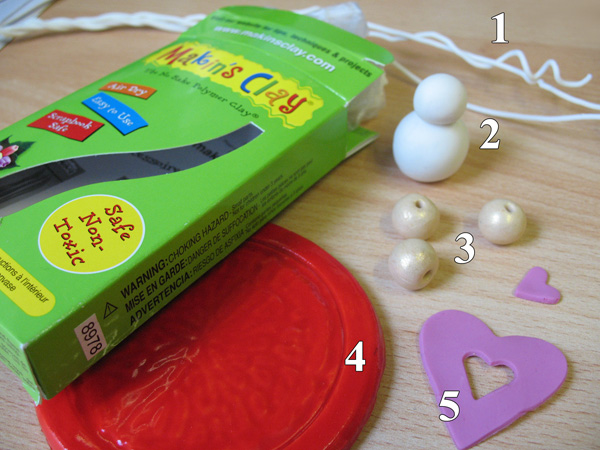
MAKINS CLAY HAS NOW BEEN DISCONTINUED BY GEORGE WEIL, we recommend DAS air drying clay as an alternative. Makin’s Clay has been formulated as an air-dry polymer clay and the ‘safe non-toxic’ message on the box makes it ideal for children (over 3 years old) to use. According to these instructions inside the box, Makin’s […]
02
Nov
Nov
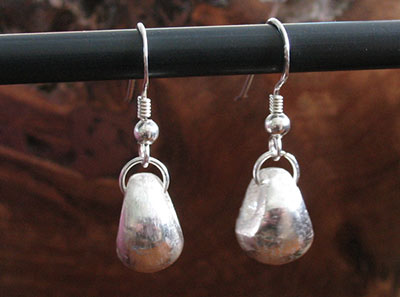
These silver earrings were made from Art Clay Silver clay. They are a simple project for anyone who has never used this precious metal clay. I used just 10g (5g for each earring) which I divided into two pieces. Digital scales are useful for weighing into equal sizes. To make the shape, I rolled each […]

08
Aug
Aug
The Pocket Color Wheel (yes color – it is made in the U.S.A.) is an essential tool for learning all about colour. The wheel consists of three cardboard discs which are joined in the centre. The middle wheel has the 12 main colours positioned equally around the edge while the discs either side have holes […]
18
Apr
Apr
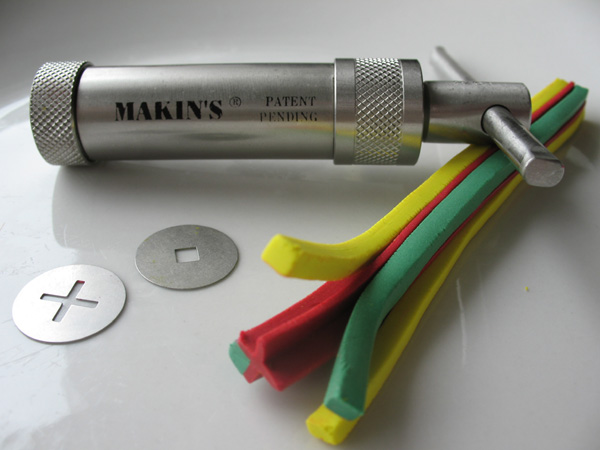
Method You can use the Makin’s extruder to create consistently sized and shaped polymer clay ‘logs’ for making canes to decorate beads etc (see how to use the extruder from our page Using an Extruder with Polymer Clay). For this cane, three colours of clay and two disc shapes were chosen. The red clay was […]